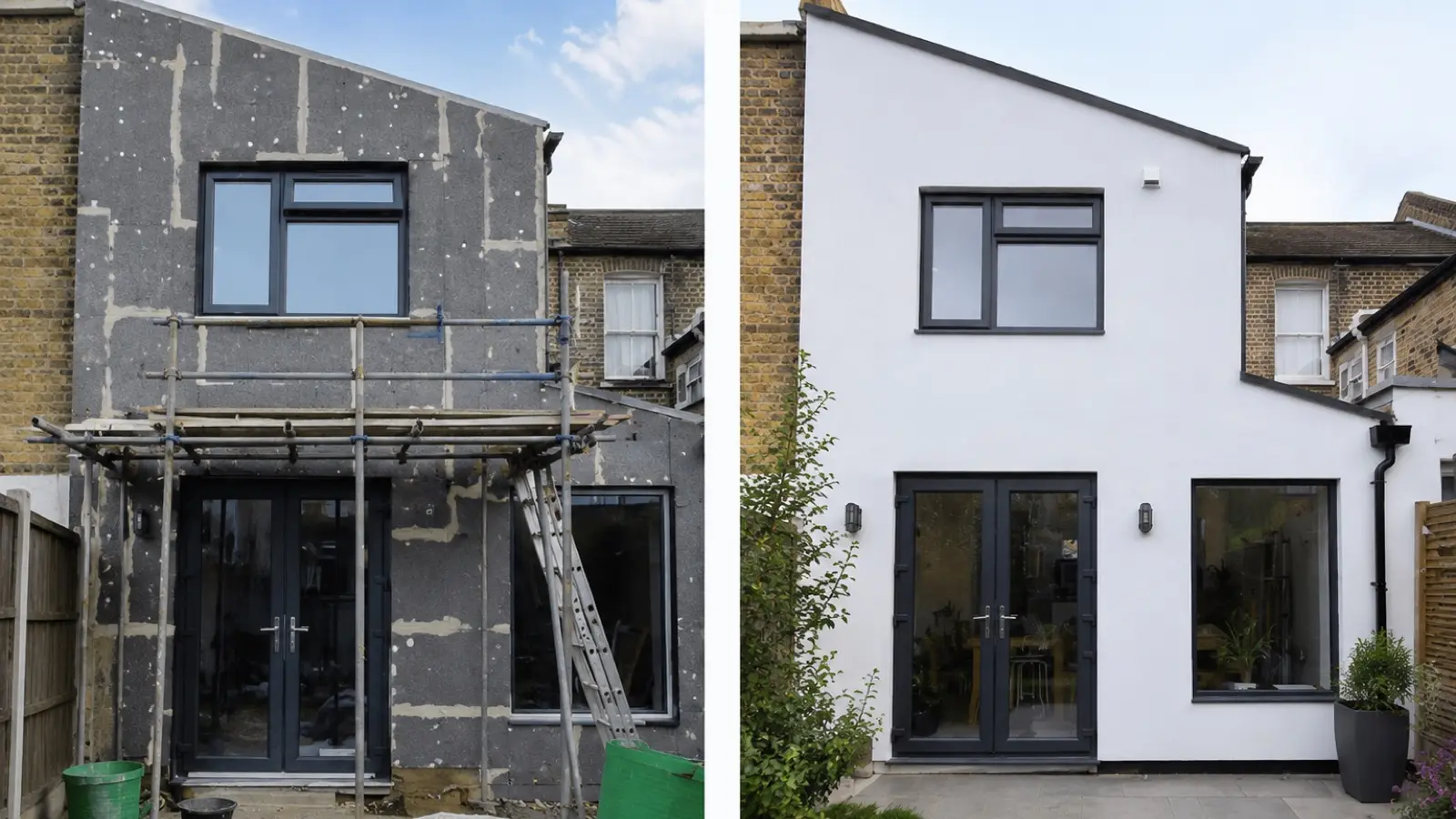
External wall insulation is not a small job. It is insulation board fixed to the outside of the house, a reinforced base coat over it, and a render finish on top — so you are paying for the render either way, plus the insulation, plus the extra detailing around every window. The honest answer to “is it worth it” is: for the right house, clearly yes, and for the wrong house, it is an expensive way to get a new render.
Here is how to tell which one you have.
Who it genuinely helps
EWI earns its keep on a solid-wall property — no cavity to fill, usually built before 1930, though plenty of 1930s to 1960s houses have solid or hard-to-treat walls too. On a house like that, up to a third of your heat goes straight out through the walls, and there is no cheaper fix available. If you have:
- high heating bills on an older house with no cavity insulation
- condensation or black mould on the inside of external walls
- cold patches you can feel around window reveals and in corners
- an EPC in D or E that you need to lift, especially a rental
then EWI does all of that in one go. It is the only wall-insulation option for a solid wall, and it deals with the condensation because the inside face of the wall stays warm enough to stop water forming on it.
The payback maths
A typical solid-wall Bristol semi loses roughly 25–35% of its heat through the walls. EWI cuts that dramatically, and the saving in practice tends to land around £400–£600 a year at current energy prices — more on a larger or more exposed house, less on a small terrace.
Against that, a full EWI job is a five-figure sum. The rough payback is eight to twelve years on energy savings alone. That is before you count the render you were going to pay for anyway if the existing one has failed — in which case the extra cost of the insulation over a plain re-render pays back a lot faster.
It is a long-term investment, not a quick win. If you are moving in three years, the sums are different, though the EPC uplift and the fresh exterior do show up in the sale price.
What it adds beyond the bills
- EPC rating typically up by two to three bands — often D to B.
- MEES compliance. Rental properties must hit EPC E now, and the minimum is set to rise. EWI is often the single measure that gets a solid-wall rental over the line.
- A new exterior. The whole house gets a fresh silicone or monocouche finish as part of the job, so failing render and tired pebbledash go at the same time.
- No more condensation. Warm walls do not grow mould.
The catches nobody mentions
- Building Control. EWI is notifiable work. It has to be signed off, and the specification has to meet current U-value targets. We handle the notification, but it is part of the job and part of the cost.
- Reveals get tighter. Adding 80–150mm to the outside of the house narrows the visible window and door reveals. On most houses it looks fine once rendered; on some it means moving downpipes, extending sills, and adapting the eaves. A good survey flags all of this before you commit.
- It is not for every wall. Some elevations are too close to a boundary, some have features that make it impractical, and listed or conservation-area properties need a sympathetic approach and sometimes consent.
- Funding is means-tested. ECO4 and the Great British Insulation Scheme can cover part or all of the cost, but eligibility depends on household income or benefits and the property’s EPC. It is worth checking before you assume you are paying full price — we can point you at the application.
The short version
If your house has solid walls, high bills and cold rooms, EWI is one of the few things that genuinely fixes all three, and the payback is real if you are staying put. If your walls already have cavity insulation, or you mainly want a new render finish, insulate the loft and the floors first and put a plain silicone render on the walls — you will get most of the comfort for a fraction of the cost.
