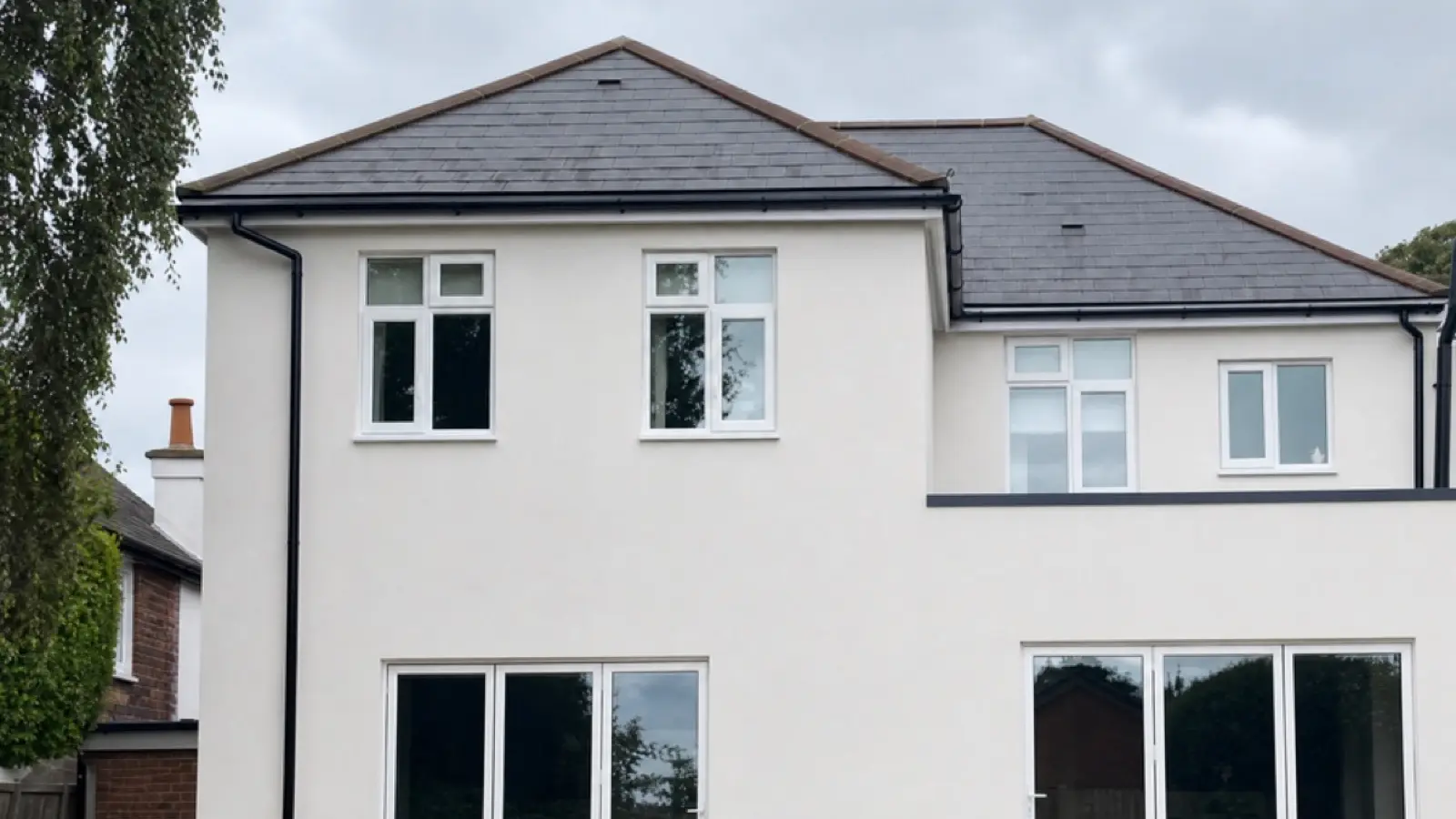
Georgian and early-Victorian houses in Bath are built differently from anything that went up after about 1920. Solid stone walls, lime mortar, no cavity, no damp-proof course. They were designed to get wet and then dry out again — the whole wall breathes. Put the wrong render on one and you stop it breathing, and the damage goes inward.
This is the single most important decision on a period Bath render, so it is worth understanding rather than leaving to whoever quotes cheapest.
Why the wall needs to breathe
A solid lime wall manages moisture by letting it pass through. Rain soaks into the outer face, and in dry weather it evaporates back out. Lime mortar and lime render are soft and porous enough to let that happen. As long as the wall can dry outward faster than it wets, it stays sound and the inside stays dry.
What cement render does
Sand-and-cement render, and most standard polymer renders, are hard and largely vapour-closed. On a cavity-walled 1970s house that is fine. On a solid lime wall it is a problem:
- Water still gets into the wall — through cracks, around windows, up from the ground — but now it cannot evaporate outward through the render.
- It moves inward instead, and shows up as damp patches and peeling paint on the inside walls.
- Trapped moisture freezes in winter and spalls the stone and the lime mortar behind the render, where you cannot see it until the render comes off.
- The cement render itself, being rigid, cracks as the soft wall moves, and the cracks let in more water.
Ten to fifteen years of that and the bill is not a re-render, it is a re-render plus masonry repair.
Lime render — the traditional answer
| For | Against |
|---|---|
| Fully breathable — matches how the wall works | Slower to apply, longer project |
| Soft and flexible — moves with the wall, does not crack | Weather-sensitive to lay; no frost, no baking sun |
| Sympathetic finish, what a conservation officer wants | More expensive per m² |
| Repairable in patches for decades | Needs occasional limewash / maintenance |
| No consent friction on a listed elevation | Narrower colour range, softer look |
Lime is the right answer for a listed Georgian elevation, for a wall that is already in poor condition, and for anyone who wants the building done properly for the next fifty years.
Lime-compatible modern systems — the middle path
Some through-colour silicone and mineral renders are formulated to be vapour-open enough to sit on a lime substrate. They are not the same as true lime, but they breathe far better than cement, they are more durable and quicker to apply than lime, and they come in a full colour range.
They are a fair compromise on:
- Victorian and Edwardian properties, which are often a bit more forgiving than true Georgian
- rear and side elevations that are not in public view
- houses that are not listed, where the conservation officer is content with a breathable modern finish
They are not the answer on a listed principal elevation, or on a wall that is holding a lot of damp and needs the maximum breathability it can get.
How to decide
- Is it listed, or on a sensitive conservation-area elevation? If yes, assume lime, and confirm with BANES.
- What condition is the wall in? A wall that is already damp or spalling needs the most breathable option available — lime.
- Is the elevation on show? Front elevations lean towards lime for the look as much as the physics; hidden elevations have more latitude.
- What is the budget and timescale? Lime costs more and takes longer. That is real, and it is worth it on the right wall.
One thing not to do
Do not let anyone put standard sand-and-cement or a standard polymer render on a solid lime wall because it is cheaper and faster. It is the most common mistake on period Bath houses and the most expensive one to undo. If a quote does not say what system it is using and why, ask — and if the answer is “it’ll be fine”, get another quote.
