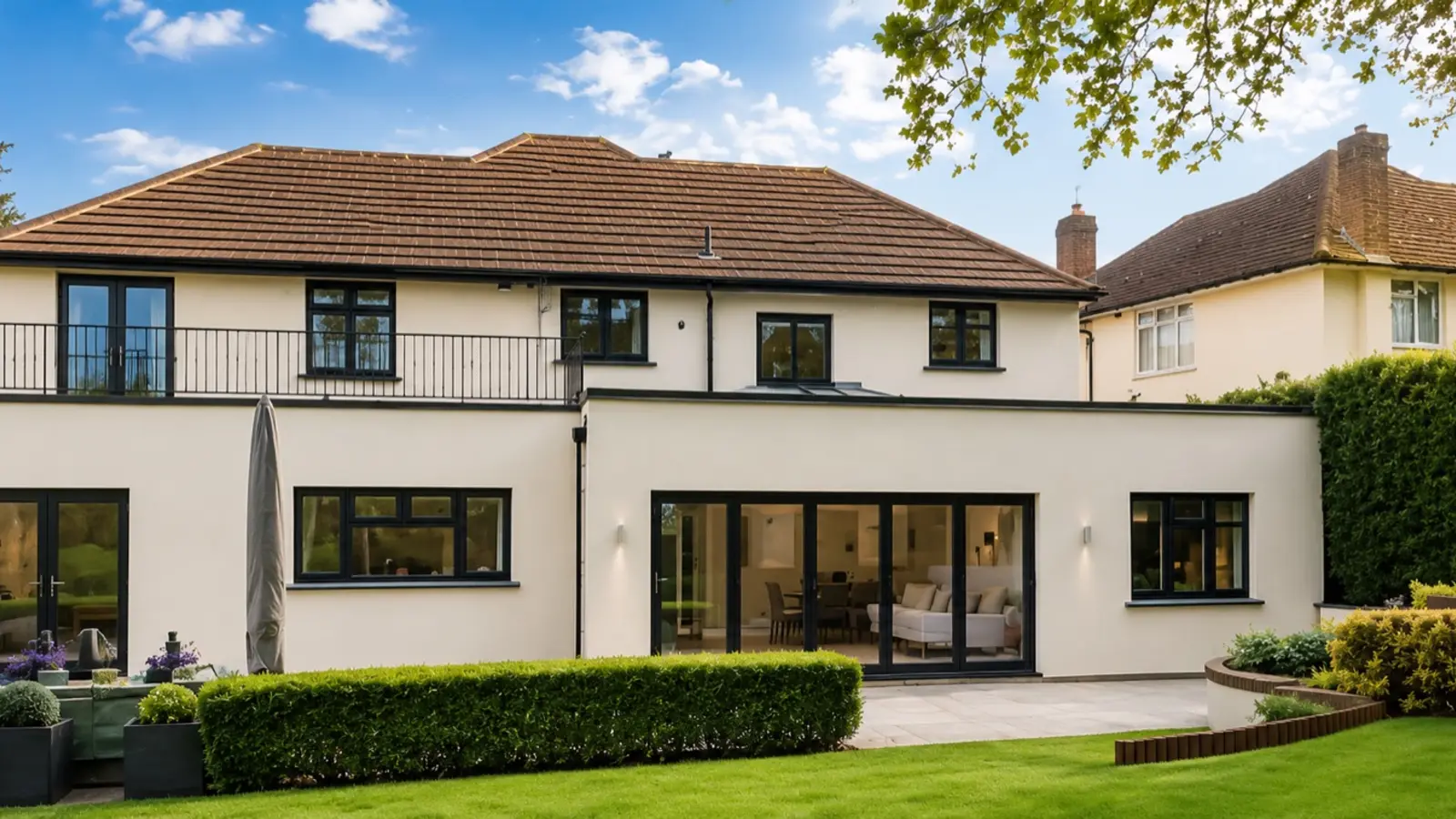
Nearly every survey starts the same way: which one do we want? Here is the honest comparison, including where each system is the wrong answer.
The short version
| Sand-and-cement | Monocouche | Silicone | |
|---|---|---|---|
| Cost per m² | Lowest | £50 – £75 | £60 – £90 |
| Colour | Painted | Through-colour | Through-colour |
| Repainting | Every 3–5 years | Never | Never |
| Flexibility | Rigid | Some | High |
| Water | Absorbs | Sheds | Beads off |
| Breathable | Poorly | Yes | Yes |
Sand-and-cement
The traditional system, and the one we spend most of our time removing.
It is rigid. Buildings move — thermal, seasonal, settlement — and a rigid render cracks where the movement concentrates: corners, window reveals, above lintels. Once it is cracked, water gets behind it, and the render starts to debond from the substrate in sheets.
It also has to be painted, which means repainting every three to five years. That cost never appears in the original quote.
There is one case where it is still right: a repair matched into a large existing sand-and-cement elevation that is otherwise sound. Patching silicone into cement looks exactly like what it is.
Monocouche
A through-colour mineral render — limestone aggregate, white cement, pigment and additives — applied in one 12–18mm coat and scraped back to expose the aggregate.
Through-colour means the colour runs the full depth, so a chip shows the same colour rather than the base coat. No painting, ever.
It is a mineral system, so it is hard-wearing and impact-resistant. That makes it a good choice on elevations that take knocks — driveways, alleyways, anywhere near parking. We fit Weber, K Rend and Parex monocouche.
Where it struggles: it is less flexible than silicone. On a substrate that moves — an older property, or a mixed substrate where an extension meets the original wall — the scraped finish can show hairline crazing.
Silicone
A thin-coat system over a reinforced base coat and mesh. The silicone content makes it hydrophobic: rain beads and runs off rather than soaking in.
Two things follow from that. Rain carries surface dirt off with it, so the wall stays cleaner for longer. And a wall that stays dry grows less algae, which is what actually discolours north-facing elevations.
It is also flexible, so it copes with movement far better than either of the others. On a mixed substrate — original brick plus a newer extension — it is usually the only sensible answer.
We fit Johnstone’s Stormshield, K Rend Silicone K1.5, Parex Silicone Finish and weber.rend Silicone. All BBA-certified, all with a manufacturer warranty behind the system rather than just our workmanship.
It is the most expensive of the three per square metre, and worth it on most properties.
The question that actually decides it
Not budget. What is the wall made of, and does it move?
- Solid wall, older property, any sign of movement → silicone. The flexibility is the whole point.
- Sound modern substrate, wants a mineral finish, impact-resistant → monocouche.
- Small repair into a large sound cement elevation → match what is there.
That is why we survey before quoting rather than pricing over the phone. On a 1930s semi with failing pebbledash, we do not know what the substrate looks like until it is off — and the substrate, not your preference, decides which of these three will still look right in fifteen years.
What to ask any quote you receive
- What happens to the existing render — stripped, or rendered over?
- Is beading and mesh included at the stress points?
- Is the warranty on the system, or only on the labour?
Vague answers to those three are the difference between a render that lasts twenty-five years and one that cracks in four.
